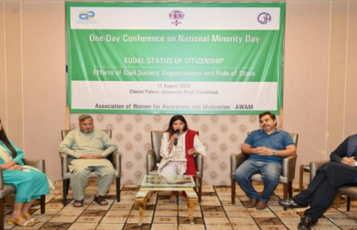
A one-day conference titled ‘Equal Status of Citizenship’ held in Faisalabad on National Minority Day highlighted the persistent marginalization of religious minorities in Pakistan, despite constitutional guarantees and statutory protections. The event, organized by the Association of Women for Awareness and Motivation (AWAM) in collaboration with the Centre for Peace and Development Initiative (CPDI) and the Christian Journalists Association Pakistan (CJAP), emphasized the need for urgent action to address the growing intolerance and repeated incidents of mob violence that have deepened divisions between majority and minority communities, undermining social cohesion and national unity.
The conference, which brought together over 110 participants—including associate professors, research scholars, youth, journalists, political activists, religious leaders, and human rights defenders—was presided over by Muhammad Faisal, Assistant Commissioner of Faisalabad. Keynote speakers included Shazia George, Executive Director of AWAM; Dr. Ghulam Mustafa, Head of the Department of International Relations at GC University Faisalabad (GCUF); Dr. Rizwan Ullah Kokab, Head of the Department of History at GCUF; former parliamentarians Habkook Gill and Noor-un-Nissan Malik; Kashif Nawab from the Christian Journalists Association; and Sonia Javed, Programme Coordinator at AWAM. The sessions were moderated by Ms. Laiba Shoukat.
Speakers at the conference underscored the importance of implementing the landmark minority judgment issued by Justice Tassaduq Hussain Jillani on June 19, 2014, as a critical step toward reversing the discrimination faced by religious minorities. They pointed out that while Pakistan’s constitution provides for the protection of religious minorities, the lack of effective enforcement mechanisms and adequate funding has rendered these legal safeguards ineffective.
Assistant Commissioner Muhammad Faisal emphasized the government’s commitment to strengthening the enforcement of laws related to religious minorities, stating, “The government is focused on combating any incidents of hatred directed towards religious minorities and ensuring their protection.”
Shazia George and Sonia Javed of AWAM stressed that “laws without the necessary institutional framework and proper funding are ineffective. A strong political will, coupled with sensitized human resources and adequate fund allocation, is essential to make a real difference.”
Former parliamentarians Noor-un-Nissan Malik and Habkook Gill called for creating an environment that guarantees the political participation of religious minorities. They also emphasized the importance of promoting democratic norms within political parties to ensure inclusive governance.
Kashif Nawab, representing the Christian Journalists Association, reminded the audience of Quaid-e-Azam Muhammad Ali Jinnah’s vision of an inclusive state where everyone is regarded as equal. He noted that “Quaid’s address to the first Constituent Assembly embodied the true essence of equality in citizenship and opportunities. However, subsequent practices have fallen short of realizing this vision.”
Dr. Ghulam Mustafa and Dr. Rizwan Ullah Kokab, associate professors at GCUF, criticized political parties for their failure to establish the rule of law and inclusive governance, which has left religious minorities vulnerable to discrimination and relegated them to second-class citizenship.
The conference concluded with a consensus on the need for immediate and sustained efforts to address the socio-political factors contributing to the exclusion and discrimination of religious minorities. Participants called for the implementation of the 2014 minority judgment, the creation of an inclusive political environment, and the strengthening of legal and institutional frameworks to ensure the protection and participation of religious minorities in Pakistan.