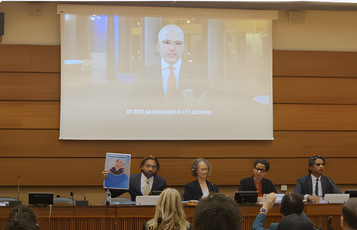
Geneva, March 11, 2025 – A high-profile side event at the 58th Regular Session of the United Nations Human Rights Council has drawn global attention to the intersection of religious persecution and torture in some of the world’s most repressive regimes. Hosted by Jubilee Campaign US and co-hosted by Set My People Free and the European Centre for Law and Justice, the event brought together human rights experts, policymakers, and survivors to discuss the grave violations occurring in Pakistan, Eritrea, Nicaragua, and Sudan.
Religious Freedom and Torture: A Global Crisis
Opening the session, Nazila Ghanea, UN Special Rapporteur on Freedom of Religion or Belief, underscored that both religious freedom and the prohibition of torture are non-derogable rights under international law. Yet, she noted, violations persist at an alarming rate.
“Religious minorities face targeted violence, the destruction of places of worship, and denial of fundamental rights. The findings in the latest A/HRC/58/49 report reinforce the urgent need for strengthened collaboration between UN mechanisms, states, and civil society,” Ghanea stated. She urged immediate international intervention to hold perpetrators accountable.
Pakistan’s Blasphemy Laws Under Scrutiny
Charlie Weimers, a Member of the European Parliament, described the persecution of Christians as a “moral crisis”, specifically condemning Pakistan’s blasphemy laws, which he argued are weaponized to suppress minorities.
“Christians in Pakistan face mob violence, wrongful imprisonment, and forced conversions. The Jaranwala riots, where 26 churches were burned, show the lack of justice for the Christian community,” Weimers said, calling for the European Union to condition trade, aid, and visa policies on human rights reforms.
Joseph Janssen, a minority rights activist, provided a harrowing account of how Pakistan’s blasphemy laws and forced conversions have fueled widespread oppression.
“Blasphemy accusations lead to torture, solitary confinement, and mob lynchings. Families of abducted Christian and Hindu girls have little recourse due to judicial bias,” Janssen stated, urging international pressure on Pakistan to repeal oppressive laws and ensure justice for victims.
Escalating Religious Repression in Eritrea and Nicaragua
Thibault van den Bossche, a representative of the European Centre for Law and Justice, condemned the Ortega-Murillo regime in Nicaragua for its severe crackdown on the Catholic Church.
“More than 5,600 Christian organizations have been dissolved, 5,000 religious processions banned, and 250 clergy members exiled. Clergy members endure psychological and physical torture, including relentless interrogations and solitary confinement,” van den Bossche warned, calling for sanctions and increased diplomatic pressure on Nicaragua’s government.
Similarly, Elsa Chyrum, Director of Human Rights Concern Eritrea, described Eritrea’s ongoing persecution of religious groups, where only four religious denominations are legally recognized, while others—including Pentecostals and Jehovah’s Witnesses—face arrests, torture, and extrajudicial killings.
“Prisoners are held in metal shipping containers, subjected to starvation, electric shocks, and sexual violence. The UN has classified these actions as crimes against humanity, yet the Eritrean government blocks access to human rights monitors,” Chyrum revealed.
Call for International Action
Speakers unanimously urged the UN, the European Union, and national governments to take decisive action against state-sanctioned religious persecution and torture. Recommendations included:
Shahid Mobeen, President of the Italian Roundtable on Religious Freedom, criticized the failure of global institutions to respond adequately.
“The murders of Shahbaz Bhatti and Salman Taseer in Pakistan illustrate the deadly consequences of defending religious freedom. The international community must move beyond rhetoric and take bold action,” Mobeen emphasized.
With 307 million Christians facing persecution worldwide, panellists stressed that religious persecution and torture constitute crimes against humanity, requiring immediate global intervention.
As the UN Human Rights Council session continues, the world watches to see whether concrete action will follow these urgent calls for justice.